







The basses
Early days
The first bass I had, I bought for a couple of quid from someone at school. It was a rather vile thing, a green sunbursty semi-acoustic, called something like a Rosetti 7 (it is some decades ago now), with a body apparently made of hardboard, or maybe papier-maché. I don't remember what happened to that (probably amnesia induced by the trauma of owning the thing). That would have been somewhere about 1973.Hayman 40/40
A couple of years later, I went to London University, and four of us in the hall of residence formed a band. As the inferior guitarist, I got the job of bassist, which I initially did by playing the bass strings of my guitar. Then there was a fire at the Fender Soundhouse on Tottenham Court Road and they sold off the stock that had been there and was possibly water- or fire-damaged. Hayman had also just gone bust, and there were lots of Hayman parts in there. Originally I planned a twin-neck but all the bodies had gone, so I put together a Hayman 40/40. This was to be my bass for the next seven or eight years. I didn't do much playing after dropping out of university in 1976, and was more interested in the guitar than the bass. However, I moved to Tamworth in 1980 and decided to get back to playing, and bassists were in demand, so out came the Hayman again.Burns Bison and a missed opportunity
For some reason, I bought a Burns Bison in about 1982. The man I bought it off was also selling an original Hofner violin bass for the same money, which I tried but didn't like (they are really quite unpleasant things to play). With just a little foresight, I could have sorted out my pension arrangements...The Fender years
Ultimately, both the Hayman and the Burns went in exchange for a tatty but very playable Fender Precision. This got various changes, like Di Marzio pickups and (for a while) active circuitry, with the scratchplate modified somewhat with a brass end part, rather like a Jazz bass. Oh, and stripping the extremely tatty sunburst off the body. It had a very good neck on it - very good for slap bass, given my level of imprecision, because the strings were nice and widely spaced.Fretlesseses
I decided to try out fretless some time after getting the Precision, and bought a Frontier, which was, in retrospect, a good bass. For some reason (can't remember exactly why), I later part-exchanged it for a Fender Precision fretless, which initially led to some confusion, as the dot markers were in different places - I can't remember which way round it was, but on one they were where they'd be on a fretted bass (midway between frets), and on the other (I think it was the Precision), they were where the actual fret would be. At some point I also owned a Wilkes fretless, which had brass "slap plates" near the end of the fretboard and a piezo microphone under the neck joint for slap playing - pretty useless for me with my inpet slapping.Headlesseses
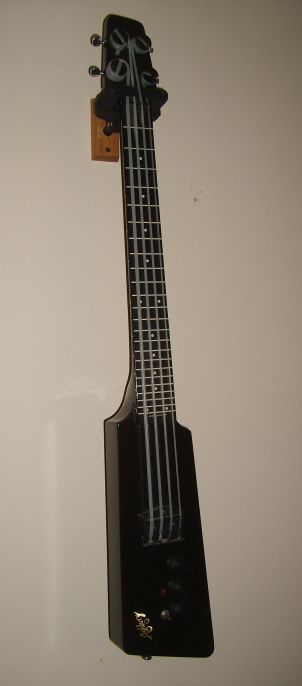
A Hohner B2 also came my way, a very convenient bass for carrying around and also very playable, though the strings were a bit closely spaced for slap bass, which I had recently started experimenting with. The passive electronics worked well enough for my needs. I think in the modern climate of fear and guns, I'd be rather more reluctant to carry it round in its gig-bag as I was then, as it has a certain gunnish quality about it...The Warwick road
Then I went into (what was then) Musical Exchanges in Birmingham to try out an effects pedal (an octaver, I think) and they put a Warwick Streamer in my hands to test it with. The Streamer had rather a high action and thick neck, not as good as my own basses, and I got a Thumb bass down instead. That proved my undoing, as it was simply the best bass I'd ever played and I really wanted it. My big fear (and bear in mind that I do, and did, rate myself as a pretty reasonable bassist) was that I wouldn't be able to do it justice. I persuaded myself that I would, and the fretted Precision and the Hohner went in part-exchange (along with a bass belonging to our singer that he wanted rid of, one of the ghastly aluminium-necked Kramers). This was in about 1988, and that Warwick (a JD Thumb, named after John Davies who designed it) remains my favourite bass, even though it's not getting used much.More fretless
I hadn't given up on fretless, and my next fretless bass (replacing the Fender) was also my first five-string - a Maison. This was a good bass, but I felt I wasn't really using the fifth string and that I might as well go back to four strings and a slimmer neck. Incidentally, at this time I was playing in a duo, Bleeding Hearts (the current Bleeding Hearts is a direct descendant of that duo, though rather musically different) and we did a demo tape. Brum Beat, a now-defunct Birmingham music magazine, reviewed it and said that one track, a song of mine called "Love Lies Bleeding", would benefit from being done with a fretless. I'd have been more impressed by that bit of musical insight had it not been for the fact that it was, indeed, done with a fretless, that very Maison 5-string.Anyroadup, the Maison got replaced by a Bass Collection four-string fretless. I never managed to really bond with this, probably because my favourite instruments (the Fenders and the Warwick) were heavy and the Bass Collection was very light (although the neck was excellent, it was a lovely bass to play, and very attractive), and so I replaced it with a Vester which had been professionally defretted. This is a Warwick Thumb copy with a bolt-on neck but, although the defretting had been well done, the nut grooves hadn't been taken down to match. I took it to Guitar Spares in Birmingham, who did the nut grooves properly and set it up for me for £15.
More headlesses
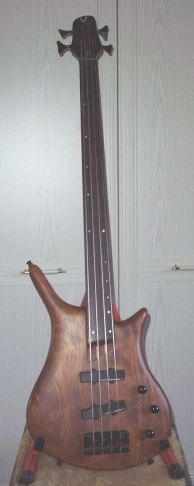
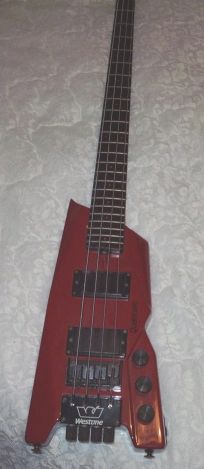
At some point, I was having problems with cars, and so I bought a Westone Quantum headless bass so I could (with the Gallien Kreuger 200MB) carry all my bass gear round by bike. That finally got sold on in 2004 - didn't get much use but I did once go down to near Canterbury with it and the GK on the bike, around a 400 mile round trip.
I still had fond memories of the B2 (which is a Steinberger licensed copy), and when I saw an advert for a 5-string Steinberger, I went and looked at it. It wasn't the cricket bat Steinberger, it was an XZ-25, but I decided to buy it anyway (bargain price!) and that spent a while with me. The neck was very playable and felt very solid and stable. Ultimately it got sold on, as I just wasn't using it.
Less and less
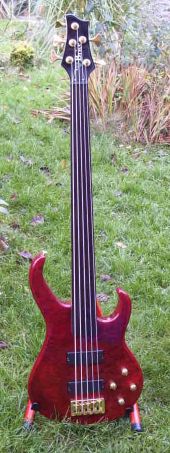
The next arrival was a Brice V2 fretless five-string. Flippin' 'eck, I thought the pickups on the Vester were powerful. This blew the doors off...The weight was nice - marginally lighter than the Warwick but heavier than the Bass Collection was. The neck profile was rather unusual, the central part of the rear of the neck being very flat. Position markers were at the fret points, which I find helpful. Setup was good from the factory, I felt no need to do any adjustment to it at all. The one thing I found was that the sound, though the pickups were hugely powerful, wasn't as biting as I'd like - I needed to edge the treble up somewhat. I used it for a little while, but never really settled with it, and parted with it again.
Six strings
While I was having the Vester set up, I made the mistake of wandering round a couple of music shops nearby. It didn't actually cost me money at the time, but I did have a play on an Axl AAB-336 Tiger Pro six-string bass. Very nice, I thought, very manageable for a six-string. And then, a few weeks later, one came up on eBay. Damn you, eBay! Damn you, music shops! So it was that I bought a six-string to exercise my left hand. The neck was really good - I've since compared it to various other six-strings (generally costing twice as much) and it was actually the nicest to play that I've encountered (I have subsequently found a better one, see below). However, I didn't really use it, and because I have fairly small hands, the extra reach across the top string put a bit too much strain on my fingers and my left hand tired rather quickly. It's now gone, although I have returned to 6-string playing.
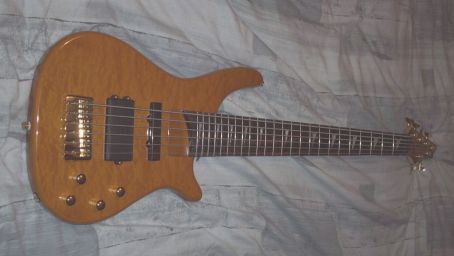
Dream team
Sometime in 2005 I found something else on Ebay - a Warwick Thumb fretted 4-string, which seemed a bit of a bargain. So I bought it and had it defretted by Joe at Guitar Spares (just by Sound Control in Birmingham) to replace the Vester, and the neck reprofiled. It's a late model Thumb, so it had the horrible thick neck rather than the slim neck of the JD Thumb that is my fretted bass. Joe measured up the neck of the vintage Thumb and skimmed the neck of the (now) fretless down to the same dimensions. The fret grooves were filled with a slightly lighter coloured filler, so it's discreetly lined. At first I had flatwound strings on it, but I never felt very happy with them so it now wears roundwounds - Elite Stadiums, like the fretted Warwick. That simple change transformed the feel, making me much more comfortable with it. Now the only reason I'd part with it is for an actual JD Thumb fretless.Up right and outa sight
Another ambition was to have an electric upright bass. Ebay yet again provided the answer, a BSX upright bass, similar to their current Flip bass. It has the same scale length as a standard bass guitar, piezo pickups in the bridge, and stands on a camera tripod. I used it with Second Time Round, the acousticish duo I'm in, and with Breakaway, the covers band. I also used it with New Corona Band, the barn dance band I play with, prior to getting the Palatino (below).I later tried out a proper double bass to see if I would get on with the long scale length. That didn't prove a problem (I have a good span, even with size 9 hands) but I found the right hand awkward, probably because I was standing in the wrong place (getting behind it, as per bass guitar, rather than beside it). Anyway, it wouldn't fit easily in a Mondeo. So I kept an eye out for a 3/4 scale electric upright bass and finished up with a Palatino VE-500 - in fact, with two, as the first one was broken in shipping and the shop (Martin's Musikshop in Germany) replaced it. This has an endpin rather than a stand (although it's possible to use a cymbal stand with it).
I used the BSX bass for Breakaway and Second Time Round, and the Palatino for New Corona Band. This was mainly due to the stand situation - with a barn dance, there are big rests between playing and plenty of warning to pick the bass up (I can't stay standing all the time - an old back injury from a motorcycle crash places certain limits on me, like not standing for more than about 30 minutes at a time, which is why I perch on a bar stool when playing with Breakaway). I did like the full scale neck though, so I went on the lookout for a Ned Steinberger bass or possibly an Ergo Bass, both of which are full scale and have stands.
I finally cracked and bought an NS WAV-4 brand new from Musikhaus Thomann - this is the entry-level Ned Steinberger bass, with passive electrics (so I'm using a hi-z preamp to cope with the piezo output, either a Behringer ADI21 or a Behringer MIC200). The BSX and Palatino are now both gone.
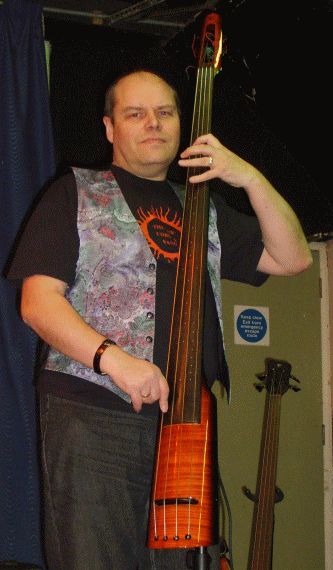
Later still, I bought an Ergo Instruments 5-string upright. However, after using it for a while, I decided that I preferred four strings on an upright so the Ergo was sold and the WAV-4 became the upright of choice again.
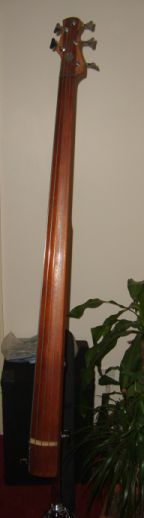
Five alive
Sound Control in Birmingham (who were once Musical Exchange, where I bought the Warwick) have a "Deal or no deal" section where you can make an offer for instruments they're trying to flog off. I bought a Squier Standard P-Bass V (or some similar combination of letters), a perfectly competent 5-string with passive J-type pickups in a Precision body. I played it a bit - must admit that part of the reason for buying it was for possible resale, and part of the reason was because I thought it should be getting played.
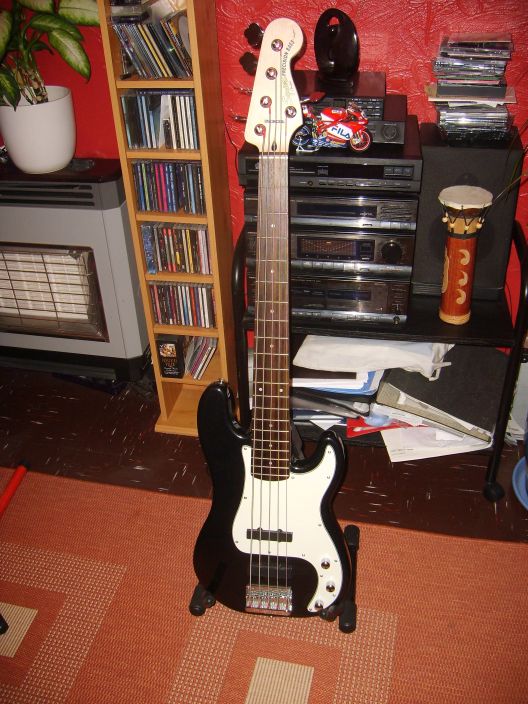
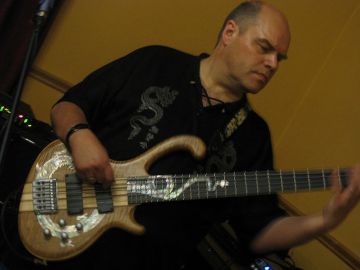
However, I found myself unable to resist the lure of Antonio Tsai's inlaid instruments on ebay, and so it was that I bought a lovely 5-string bass. When it arrived, I was smitten by it straight away - like the JD Thumb, the neck is shallow and fast, and a little narrower than the Fender. So the Fender went, and the Tsai got promoted to gigging bass. I've played 5-strings on and off over the years, and I've actually managed to settle with this one. I used it for a good while for the rock/blues covers band The Lightning, and it's still with me - I have no intentions of getting rid of it, in fact I've upgraded it with Bartolini pickups and a Delano Sonar preamp.
Seven - heaven?
I decided to take on new challenges - one of them being a 7-string bass. Again I went for a Tony Tsai bass, but this time it was something of a disaster. It looked lovely and the neck felt good, but only six of the strings sounded - the active area of the pickup was marginally too small to span all seven strings. The fretting wasn't terribly good (it's all in the right place but needs some tidying up) and the nut was rubbish - on two of the middle strings, if you fret between the 2nd and 3rd frets, there was no clearance from string to 1st fret. Some modification was in order, starting with a pair of Bartolini G66JD pickups and a new bone nut.
Absolutely rubbery
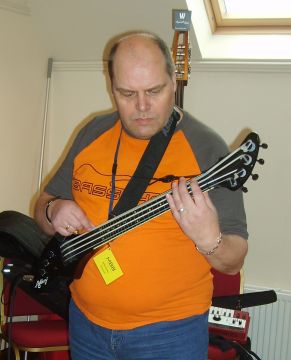
I have had a certain fascination with the tiny rubber-string Ashbory bass for a while, and finally got both the money and the opportunity to pick one up. This was a Guild original, with unweildy banjo tuners, which aren't that bad but when you're used to normal machine heads, it's rather inconvenient to tune it. Putting that moan aside, I spent ten minutes getting acquainted with it and then took it out for a gig. I found it great fun, although the tuners were an annoyance..
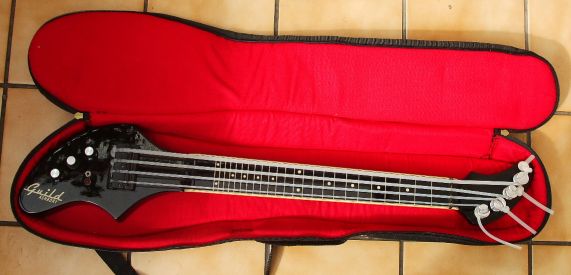
A few months later, I took the opportunity to buy the later version (the current production version), which uses modified normal machine heads.
I have modified the electronics a little in order to increase the gain - details here.
Fret not
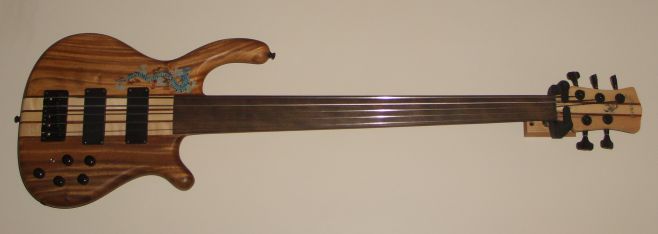
Still on the quest for a 5-string fretless that I was happy with, I chanced on a Mazeti 5-string fretless that was being sold on the Basschat forum. I travelled down to near Portsmouth, had a go, liked it, and brought it back with me. I used it as my main instrument for the originals band Different Glory.
Bump and grind
Did I say I'd probably not bother with a 6-string again? After playing a few 5-strings in PMT, I decided that the Peavey Grind was a very nice instrument but I had no reason to buy one. Not a 5-string anyway. But when an as-new 6-string Grind appeared on ebay, I found temptation impossible to resist.
The fact that it's a passive bass is a bit of a drawback as far as I'm concerned, but I'm not overly bothered. I may fit a pre-amp in it at some point.
And subsequently, in a bit of rationalisation, I sold the Grind 6 but bought a Grind 5.
Mark up
Having become an Ashbory convert, I was keeping an eye out for a Mk 2 - these are a longer scale version of the Mk 1, restyled, and very rare. Only 80 were made. And lo and behold, I was put onto one and managed to buy it. It wasn't really used much by the original owner so I'm still getting the strings settled down. After a little testing, it seemed to be picking up mains interference, so I modified it (details here). That hasn't been successful though, so I'll have to do some more troubleshooting.
Gentle Zephyr
I was on the lookout for a second main 5-string fretted bass when I saw a Peavey appear on Ebay. The model was unspecified, but after some detective work I had it identified as a Zephyr C5 - a Europe-only passive version of the Cirrus BXP. So I bought it, and it turned out quite a nice instrument. The neck is a little thicker (deeper) than the Grind neck. It finished up getting used on one recording as the Tsai active bass I had with me was picking up some of the electrical noise in the studio.
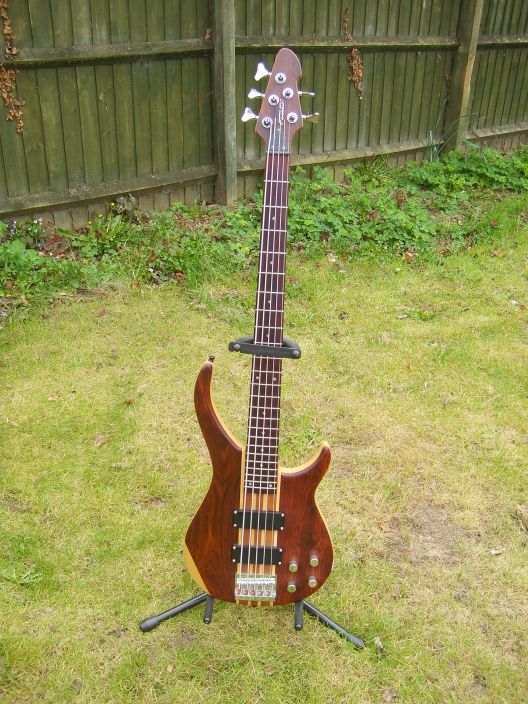
This was eventually sold in the same rationalisation as saw my Grind 6 depart.
Sei What?
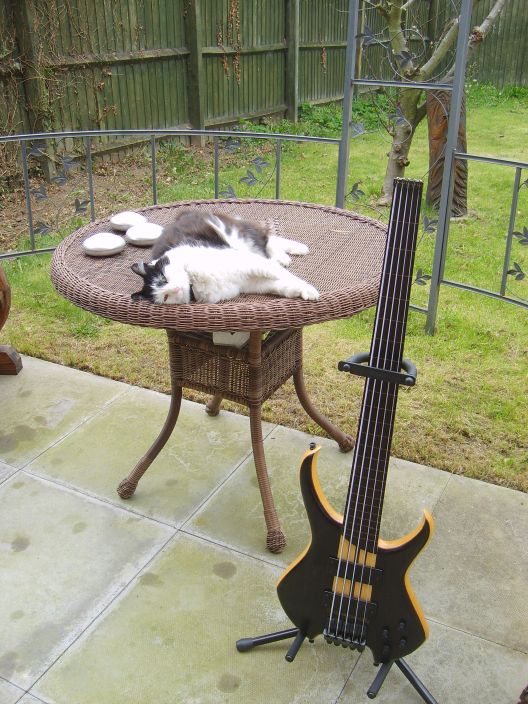
Still on the quest for the ultimate 5-string fretless, I saw a Sei headless fretless at Bass Direct. I went down and had a look, and after a few adjustments to trussrod and bridge and a bit more playing decided that this was it. The neck is shallow and asymmetrical, very comfortable to play, and the sound is rich and complex, almost chorussy in its nature. I think I can cope with it being lined somehow. Both the garden guardians approve of it too.
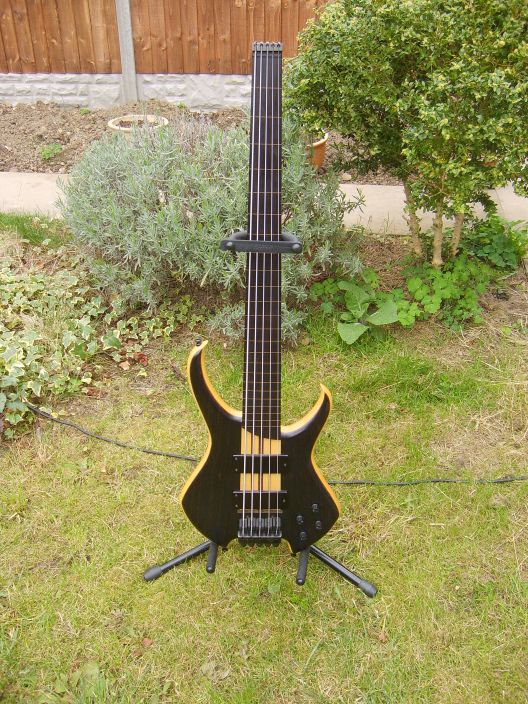
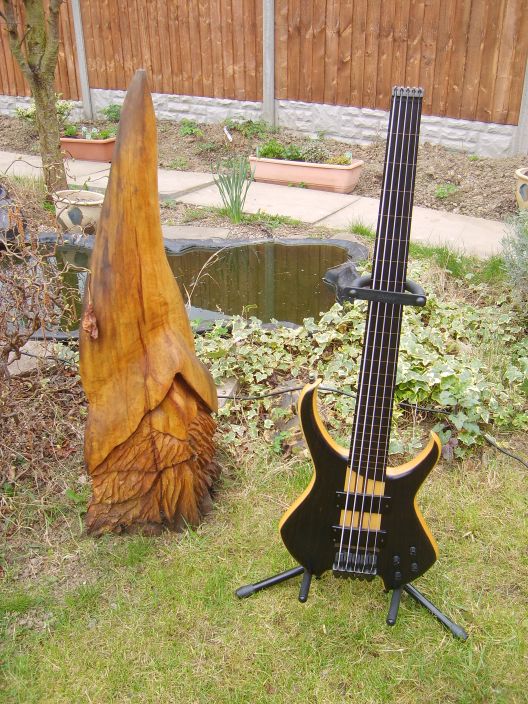
One fault has reared its head - when used on anything but completely the bridge pickup, a strange popping sort of noise was coming out. The electronics are passive pickups with a Bartolini TBIBT preamp, which has two buffer amplifiers powering the blend control, and from there the actual tone-shaping preamp. My suspicion was that a component in the buffer for the neck pickup had failed, and that theory has been confirmed by the luthier that Mark of Bass Direct uses. He bypassed the buffer stage and connected the pickups direct to the blend control. That hasn't worked terribly well (probably because the blend pots are the original low-value ones, intended for use with buffered input) so I have replaced the original preamp with a Delano Sonar 2-band preamp, which works very well.
Not cricket
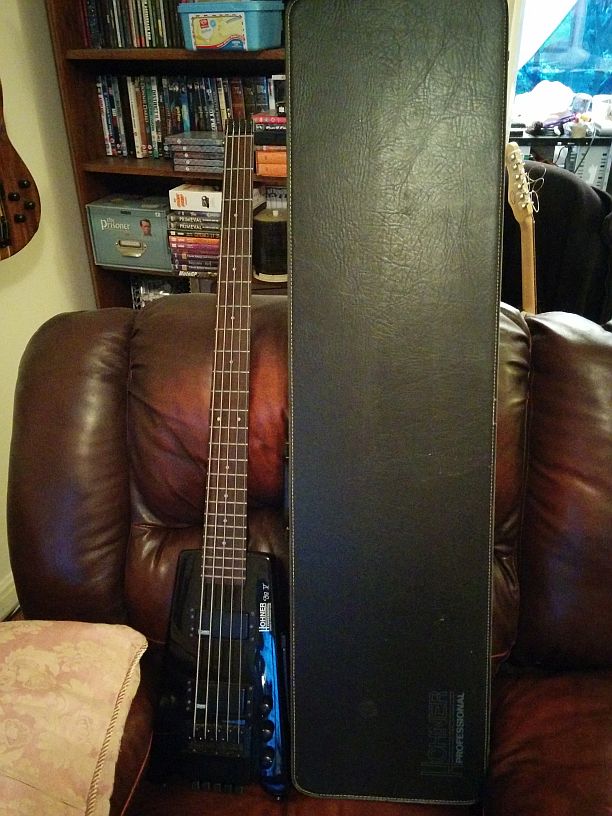
I thought that a backup bass would be useful, and one which was small enough to lose down the back of the settee was ideal. So it was back to Hohner B2s - this time a fretted B2V. However, it was black and completely undamaged and I had a dread of chipping the black paint, so I bought a natural finish walnut B2AV and sold the B2V. The B2V is pictured.
The neck profile means that it's not a bass I'd choose as my main instrument, but it's perfect as a backup.
Perfect 10
I fancied the idea of a 10-string bass, the bottom end equivalent of a 12-string guitar. 8-strings are fairly easily obtained, but the extra string pair a little less so. Dean used to make one - in fact I think they made two, one with one saddle per string and one with one saddle per string pair. The one I found on Ebay has one saddle per string, to allow for better adjustment.
I've used it a couple of times live, and for recording a few of the tracks for Gasfoodlodging.
Status No
Having played a Status 5-string or two, and fancying a headless fretted 5-string, I finished up buying a Status Series 1 equipped with LEDs. I used it on a few gigs - the LEDs, as well as being ridiculously showy, are very useful on stage as it's easy to take a quick glance and see where the markers are.
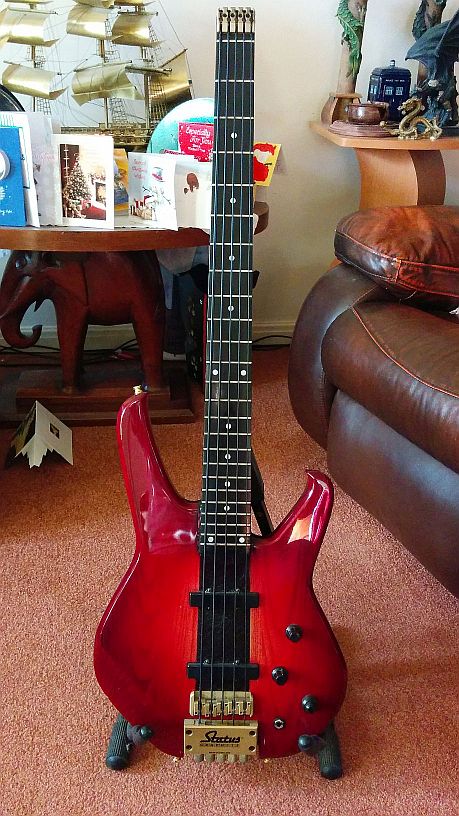
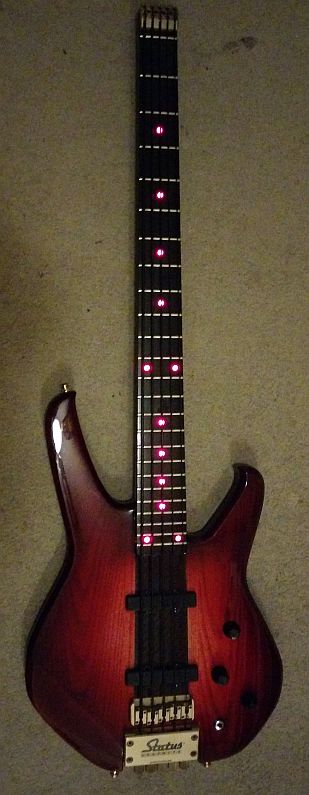
However, this was another bass that I never really bonded with, and I started looking round for something else.
Warwick Buzz
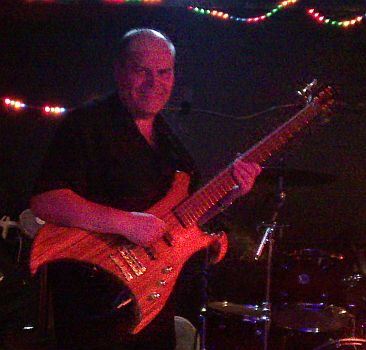
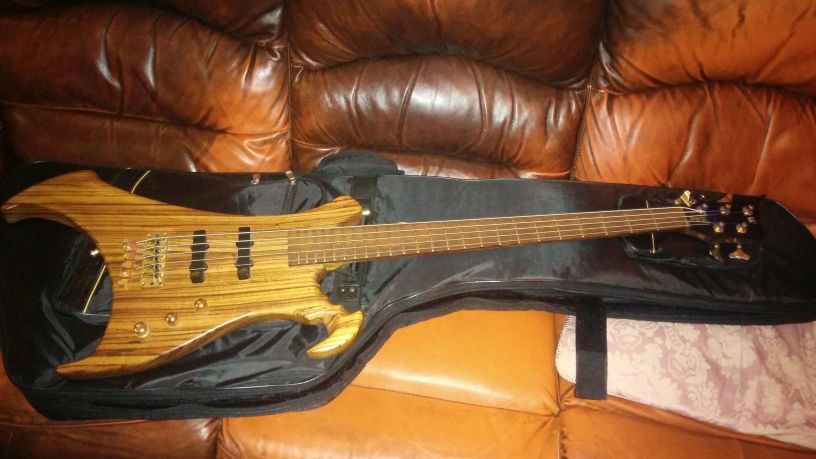
In my looking around, I happened upon a Warwick Buzzard bolt-on 5-string for which the seller was looking for a possible part-exchange with a Status. So the deal was done and I finished up the proud owner of said Buzzard.
Although the neck is very chunky, it's a very flattened profile which I get on with. There's no real top horn so the strap peg is set a long way back, but presumably due to the body wing there's no neck dive. And that wing is nicely placed to rest your forearm on. Mind you, the oddly shaped lower horn means that sitting and playing it resting on your lap is as comfortable as cuddling a hedgehog.
The biggest drawback with it is that I can't find a stand to fit it (well, there is one, made by an American, but when he told me that it would be $599 plus $100 shipping, I decided I could cope without it). Then I found that there is a stand which will just about do the job.
Sei means 6
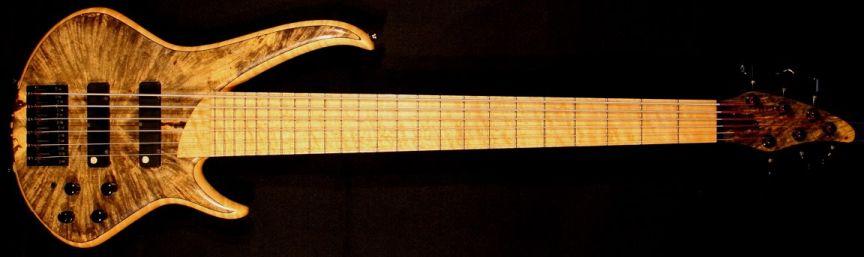
Now somewhat hooked on Sei after using my headless fretless for a couple of years, I found a Sei Flamboyant 6-string on Ebay which I persuaded myself was just what I wanted. It's a lovely bass which I'm not using at the moment, but I know sometime soon it will have its day...
The Poseidon adventure
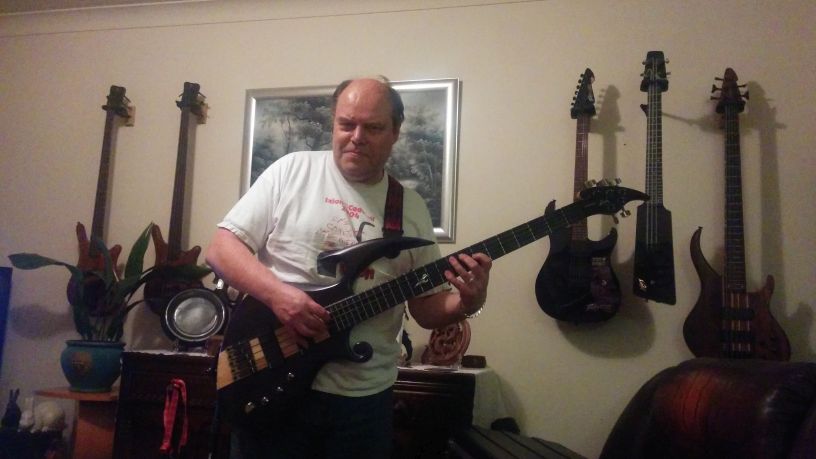
The Buzzard eventually proved too much for me, as I could barely fit it into the estate car and any stage smaller than the NEC meant me sticking the headstock into the singer's ear. As I'm married to said singer, a change was advisable. Someone on Basschat was interested in a swap for an Esh Poseidon V, and I'd fancied one for ages, so the deed was done.
It's got a pleasantly shaped neck, a little fatter than my beloved Seis but very comfortable. There's a piezo pickup on the bridge as well as the two soapbars.
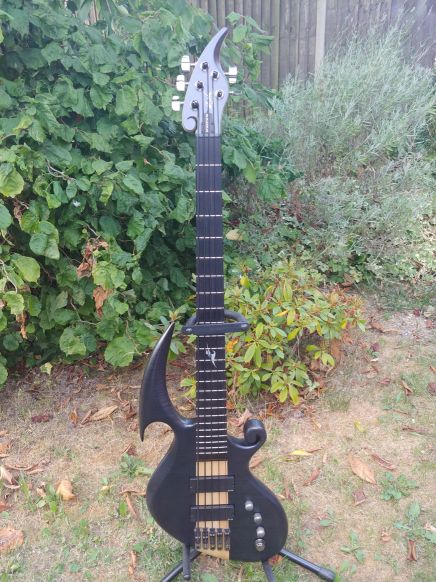
Sei fretting
I love the Sei Flamboyant body shape, as well as the Sei neck, and prefer headless to headed, and use 5 strings these days, so when a 5-string fretted Flamboyant turned up on Basschat and (just for a change) I had enough money to buy it, it was mine. Nowadays, I use either this or the Sei Original fretless for gigs.
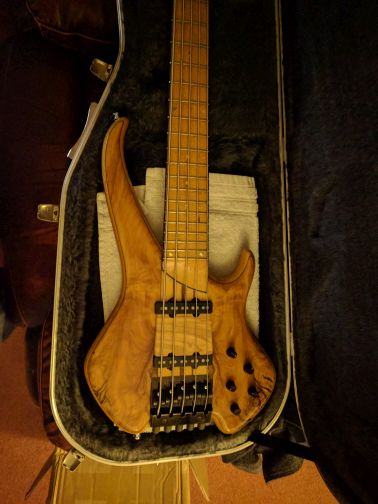
Incidentally, due to me joining a Marillion tribute band and Pete Trewavas not having the good grace to play a 5-string, the Warwick Thumbs have been dusted off and pressed back into service.